CyberDarts
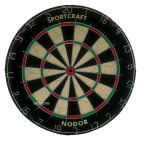 |
Tournament quality bristle dartboards are made of
natural rope fiber (sisal). These fibers are
compressed under tons of pressure and banded with
steel, then bonded to a non-warping backboard. Bristle boards are made with removable number rings, and have a center mounting point. This is to enable rotation of the dartboard. Every 4 to 5 hours of play, remove the wire number ring from the clips,rotate the dartboard until another black wedge is at the top, the replace the number ring with the 20 at the top. Rotating a dart board regularly will greatly extend its usable life. Bristle dart boards were developed in the1930's, and introduced commercially in 1936, by the NODOR company. Note: It is a common misconception that dartboards are made of hair or bristles from pigs, camels, or horses.This is a myth... No such animal fiber boards have ever been made! More dart board information: Dartboard.com |
Each player should have one set of 3 darts. Each person throws 3 darts, then removes them before the next darter throws.--> There should NEVER be more than 3 darts in a dartboard at one time.
Sharing one set of darts drastically slows down a darts game. Also, people have different hand and finger sizes, so darts are not one-size-fits-all. It is hard to pick just the right dart from a catalog or online site. You really need to try the darts before buying. When shopping for darts, visit a darts shop that has dart boards setup for trying out various darts barrel grips and materials.
Brass Darts ( $4-$20 )
Brass Darts age usally the least expensive type of metal dart.
Brass is a fairly dense (heavy) metal, is relatively inexpensive, and is easy to machine. Unfortunately, it is so soft that the machined "grip" may quickly dull and wear down, changing the "feel" of the dart. Also, since Brass Darts are commonly mass-produced, the quality and consistency of the machining may vary considerably. Brass darts are often used as "house darts" in darts bars due to low cost.Nickel/Silver Darts ( 12-$35 )
Like Brass, nickel-silver is a fairly dense (heavy) metal, is relatively inexpensive, and is easy to machine. However, Nickel/Silver is harder and therefore more durable, which prevents the dart's machined finish from wearing away as rapidly. Otherwise, these are similar to Brass Darts, and popular with budget-minded beginning darters. (Note: There is no actual Silver content; this Nickel and Tin alloy is often used for the moving parts of silver jewelry and for trophies.)
Tungsten Darts $20- $200
Tungsten is an extremely dense metal, heavier than lead. It is also very durable, so a high-density tungsten dart resists wear and the grip will last much longer. On softer metal darts, the grooves and rough knurling may wear down fairly quickly from skin acid, friction, and hitting other darts.
There are 5 rough categories of Tungsten darts.
1. 1% to 40% Tungsten- $15 - $40 (commonly sold at discount stores)
Some of the cheapest darts sold with the word Tungsten on the package may contain very little tungsten, in fact of these cheap darts just have a thin coating over a brass or steel dart barrel. Others may contain small amounts of tungsten, but in general most darts in this price range will not have either the feel or durability of a high-density tungsten dart. Be wary of discount store or sporting goods store darts that do not have the percentage of tungsten marked on the package.2. 50% to 70% Tungsten- $15 - $65 (popular beginner sets)
3. 80% Tungsten - $25 - $85 (popular with new league players)
4. 90% Tungsten - $50 - $100 (high density, will hold up well, feel better to throw.)
5. 95% to 98% Tungsten - $100 - $195 (high density, thinner dart barrel, more durable, feel better to throw.)
Nickel/Tungsten Darts are made of a high-tech material composed of Tungsten particles bound together with Nickel. They are more dense than Brass or Nickel/Silver Darts. This means smaller diameter barrels, better "feel", and tighter possible groups on the dart-board. Tungsten is also very durable, and the machined grip will not wear down as rapidly as on Brass or Nickel/Silver Darts.
Discount outlets often sell low-density Tungsten darts without specifying the percentage of Tungsten content, but just say "Tungsten Darts". Such darts are often cheap Chinese imports of poor quality. Look for the percentage of tungsten on the packaging, a higher number means that the dart is more dense, and generally better quality.
Tungsten prices have gone up in recent years, raising the price of quality darts sets. However, in order to offer "bargain" prices, many sporting good stores & discount outlets now sell cheap "Tungsten Darts" that actually contain only a tiny trace of tungsten in them. Many of these cheap sets are about the same density as brass (or less), but cost quite a bit more. Always look for the percentage of tungsten on the package, and buy from a reliable vendor.
There are also a small number of Copper-Tungsten darts available. This is a much softer material, with about 70% Tungsten content. They are generally less expensive than Nickel-Tungsten darts. Some darters, especially old-timers, like the grip of these darts as the metal surface develops microscopic pits after they have been thrown for awhile. Copper tungsten darts have become much less common in recent years, with Nickel/Tungsten darts becoming the primary type of high-density darts.
Shafts serve to hold the flights away from the center of mass of the dart barrel. The shaft acts as a lever to make the flight more effective at resisting sideways motion. A longer shaft will produce about the same effect as a larger flight. There are a plethora of different shaft designs, but all serve essentially this same purpose.
SHAFTS - Plastic
Inexpensive, and available in many colors, but break fairly easily. Good shafts until you start throwing tight groups and breaking lots of shafts. Materials are usually polycarbonate or nylon, some have replaceable tops for greater longevity. Priced from $1 to $3.SHAFTS - Composite
Composite type shafts, such as the Alamo or Quiver, have plastic bases that thread into the dart, combined with aluminum or other metal alloy tops that hold the flight. These are excellent shafts, quite durable, and will not vibrate loose as easily as solid aluminum shafts. Generally available with replaceable tops for economy and convenience. Most styles priced at $2 to $6.SHAFTS - Solid Aluminum
More rigid and durable than Plastic or Composite Shafts, in many colorful styles, some with decorative engraved stripes, flutes, or spirals. May tend to vibrate loose, especially on heavy darts. When used with thick flights, such as Dimplex or Nylon, the slots may need to be pried open slightly, with a dart tool or knife blade. Will normally bend instead of breaking when hit; just straighten for more use. Priced from $2 to $6.Note: Shafts with metal threads often vibrate loose when playing, so rubber O-ring lock washers are highly recommended. This only occurs when there is a metal-to-metal contact, so plastic shafts do not normally need the lock washers.
SHAFTS - Other metals
Stronger metals such as steel and titanium have been used to make dart shafts. These generally have a thinner profile than aluminum or plastic shafts, and sometimes are more durable. However, in most cases, the back end of the shaft that holds the flight is still made of aluminum. Since that is the part that oncoming darts can hit and damaged by a "robin hood", the overall durability is not that much better. Some models compensate by providing for replacement of the shaft's flight holder, in case it is split. Priced from $5 to $20.SHAFTS - Spinning
A variety of shaft styles allow the flight to turn out of the way when struck by another dart. Spinning shafts do nothing to improve the flight of the dart through the air. Spinner shafts do allow tighter groups by letting the flights align with each other. Also, these shaft will greatly reduce torn flights and "robin-hooded" shafts. Priced from $2 to $12.
Rules to the Darts Game of '01, (pronounced " Oh-One")
The game of '01 is the classic game of Darts, played world-wide. The "01" refers to the fact that the game is played from a certain number of points, always ending in "01". For example, the common tournament game of 501 (pronounced "Five-Oh-One"), is played from 501 points. Other variations are 301, 601, 801, 1001. The higher point games are usually played by teams.
The object of the game is simple... each dart player starts with the same score (501, for example) and the first to reduce his score to zero wins.
Players take turns throwing three darts each. All points scored are subtracted from their own beginning score (501 points). Each player removes his darts and marks his score before the opponent throws. Darts that bounce off or miss the board do not score and cannot be rethrown that turn.
The difficult part of the game lies in the finish, known as "going-out". To win, you must reach zero before your opponent, but you must also reach exactly zero, and the dart that brings the score down to zero must be a double. Doubles consist of the numbers in the outside narrow scoring band and the center (small) bullseye which counts as 50 points and is an actual double of the outer 25-point bull.
For instance, if you have 2 points left, you must hit a double-1 to bring the score down to zero. From 18 points, a double-9 would work. If you have an odd number left (a number that cannot be divided by 2), then darts must be thrown to reduce the score to an even number, before throwing at a double. For instance, there is no possible double out from 19, so a way to finish would be to throw a single-3 first, reducing the score to 16. The 16 can then be "taken-out" by throwing a double-8.
The games of 501, 601, 801, 1001, etc. are all played the same way, except for starting with more points. The game of 301 is different, however. Because of the potential for a very short game, 301 has an added difficulty...each game must start with a double. That is, each player must hit a double (any double) to start scoring. Each players scoring begins with the score of the first dart that hits a double.
There are a number of basics to keep in-mind, including several bad habits that you should avoid:
A steady Stance is very important. Don't lean way over the line to get closer to the board. This one is a tough habit for some people to beat, but try.. as leaning robs the darter of stability. The feet and legs should be positioned in a solid, comfortable, and relaxed stance, with weight distributed to both feet. Excessive leaning places nearly all of the body weight on one foot, tiring the shooter in long matches and damaging accuracy in the short run.The few inches gained by leaning over the line are simply not worth the huge loss of balance and stability. Plus, leaning lowers the shoulder, forcing one to throw upwards, fighting gravity. Leaning also usually means tensing the major muscles of the body to preserve balance. This often results in a jerky release and poor follow-through, since the body is already off-balance.
A number of long-time players report back, knee, ankle, and foot pain, from spending many years standing on one foot while playing darts. Even in the short run, leaning to throw will cause minor pain in the small of the back. Especially for older players, a firm stance will stop this discomfort, both while playing and the next morning!
If someone argues the point with you, think about this..
In what other sport would you drink a few beers, stand "tiptoe" on one foot, and then try to consistently hit a small target?In every competitive sport, Accuracy begins with a Solid Stance!
Keep your feet planted solidly on the floor, and Avoid Lunging or lifting the back foot off the floor during the toss to get a harder throw. This can really be a bad habit, as it affects the entire body and throw.Lifting the foot even partway from the floor deprives the body of good balance during the crucial moment of follow-through. The strength required to reach the board with any normal dart is minimal, and for best accuracy should be provided only by the fingers, wrist, and forearm. After the dart leaves your hand, let your hand and arm continue on towards the dartboard.
Imagine that you are bowling.. after letting go of the ball, you still must follow-through! The same applies to Golf, Billiards, Basketball, and most every other sport. Follow-through after realeasing the dart, ending up with your fingers fully extended, as though touching the spot that you want to hit.
Missing the board or hitting too low often cause beginners to think that more power is needed. This is rarely true, as one can tell by the fact that the missed darts usually hit hard enough to stick in the wall, which is quite a bit harder than a bristle dartboard. The problem lies with the accuracy of the throw and follow through. Even small children can be taught to throw accurately without lunging or using the shoulders in a throw.
If you feel short of power, stand upright, and keep your elbow up. The upper arm should be approximately parallel to the ground. This allows you to bring your arm back further, without hitting yourself in the face with the dart!
Stand Straight, Elbow Up, and you will effectively double the power of your throw without any extra effort. For one thing, the dart is much higher than when leaning, so gravity does much of the work for you.
The dart should be held in a level position, and maintain as level a stroke as possible. Don't hold the dart sideways, or in any other position than level and pointed at the board. Skill at darts, or any other target sport, means being able to perform the same motion exactly the same way, time after time.Common sense, as well of years of studies in other sports, show that all non-essential motion should be avoided and discarded from the routine.
In Darts, this means that if the dart is to strike the board at a level attitude (nearly always the best), it should be held and thrown from a position as close to level as is possible.Any other position (such as point-up, point-down, or sideways) means extra motion of all the hand and wrist muscles to correct the initial starting position. Pure wasted effort... and usually futile, since the dart will likely leave the hand at an angle and wobble all the way to the board. And the correcting motion needed to get the dart back pointed at the board imparts inertia to the dart's mass, away from the direction of the target. Then the darts will often stick in the board at odd angles. After a long period of play, when concentration starts to slip a little, this can really be obvious, with darts hitting at all sorts of different angles.
Don't "throw" the darts, instead just gently "place" them in the dartboard with a smooth motion of your hand & fingers. Throwing like a baseball is unnecessary and even dangerous, as a dart thrown too hard may hit a wire or other object and bounce clear across the room to hit someone. Dartboard wires get bent and the bristles crushed from this type of abuse.Like Golf, Billiards, and most other sports, the motion is a STROKE, not a Throw.
Fortunately "baseball throwers" usually stop after a while, either due to the laughter of spectators or the frowns of the bar manager. This method is also hopelessly inaccurate, as all of the major strength muscles and very few of the fine control muscles are used. A dart should never be thrown so hard that the front of the dart barrel touches the bristles. If this happens when a dart is thrown normally, then the dart point is too short and should be changed at a darts shop.
Don't Spin the dart as you release it to add stability. This is wasted effort at best, and spinning the darts can actually make your game worse by causing uneven release. Most darts flights are not shaped to properly induce spin, and the darts fly too short a distance (about 5 feet) for aerodynamic spin to be a stabilizing factor anyway.
Spinning the dart is often done inadvertently, and is a symptom of uneven release. As the hand opens, if the thumb leaves the dart before the fingers, the dart will roll sideways off the fingers, causing the dart to spin. All parts of the hand should leave the dart at nearly the same time to ensure level flight. To achieve this, make opening the hand a positive motion, and open the fingers and thumb rapidly to an extended position, ending up pointing at the target. This will also help keep the flights from touching the fingers as the dart leaves the hand.As an exercise to get that qucik release, imagine dipping your hand in a bucket of paint, then fling it at a spot on the wall. If your hand ends up towards the floor or ceiling, that is where the paint would have gone! Let your fingers end up naturally open and pointing at the exact spot where you want the dart to go.
1. Description
A light weight dart with a soft plastic point is thrown at a board consisting of a perforated plastic face. Each hole in the board is sized to fit the dart point and has beveled edges to facilitate entry of the point. A series of sensors and circuits behind the face of the dartboard note the impact and inform the central computer processor, which calulates and displays the score for the players to see.Note: The score displayed by the machine cannot be corrected, and for league play "the machine is always right!" No matter how badly it actually mis-scored.In early 1999, the recommended maximum weight for soft tip darts was raised to 18 grams, for league and tournament play.
The actual machines used in bars can accomodate darts up to 25 grams or more, without damage to the board. However, darts over 20 grams tend to break lots of tips, so their use is discouraged. Check with your local league to see if they enforce any weight limits, as some are quite strict, and other leagues may not care what you throw.
Manufacturers: Most coin-op machines in the USA are made by Arachnid or Medalist. The major coin-op manufacturers also help setup leagues to play on their machines, and have national competitions.Quite a few companies import and market home versions of soft-tip darts machines.
2. Measurements
Most games are played about the same way as for steel-pointed darts, except that the throwing distance is 8 feet for soft-tip machines. The height to the center of the board (the Bull) is 68 inches, the same height as an English Clockface Bristle board. Rules of play and weight limits for Soft-tip darts are generally set by the manufacturers at their annual meetings.
Darts Leagues are similar to other sports leagues, such as bowling or softball leagues. There are many variations, but the following is a general outline that applies to most dart leagues.
Leagues may be run by a group of volunteers, or the league may be run as a business. A group of players, (usually from 4 to 8) form each team, who play one night a week for a season, which may run from 8 to 40 weeks in length. During the season, each team normally plays each of the other teams several times.
In most areas, each team member must join a Darts Association, paying annual dues (typically $5-$40). This entitles you to participate in league activities, get the newsletter, if any, and sometimes get a patch, pin, or shirt with the Association logo.
Each darts team must also usually pay a team fee every season, ($10 to $75) which goes towards paying the statistician, printing scoresheets, buying trophies, jackets, etc. In many cases, the team fee is paid for by the sponsoring dart bar, that is, the pub at which the team plays darts. The bar will also often provide team shirts, imprinted with the bar logo and team name.
Some leagues also have nightly fees, or player fees. These are usually in the $2 to $10 per night range, and is normally paid back at the end of the season as prize money, or as perks such as a major party, pre-paid trip to an out-of-town tournament, or as jackets. (One soft-tip league in Texas gives every member a 4-day trip to Las Vegas at the end of the season. They fill an entire chartered plane once each year!)
If several bars participate in the League, then play is usually Home-and-Away, meaning that you play at your home bar every other week, and visit at the other teams' bars the alternate weeks. Some leagues, called In-House Leagues, play all games at just one location.Leagues in most areas play on weekday evenings, although there are quite a few local exceptions. Typical start time is 8pm, with play normally lasting from 1-1/2 to 2-1/2 hours. Play consists of a variety of games of '01 and sometimes Cricket (see RULES), with Singles, Doubles, and Team matches usually played.
Don't be afraid to join a league, due to lack of skill... Most leagues are split into divisions, of different skill levels, or have some sort of handicapping system.
For more info on Darts Leagues in your area, check theAssociation Directory.
(Steel-Point Type Bristle Dart Board)

The Official throwing distance, for most countries, is
2.37 meters, as measured along the floor, from the plane of
the face of the dartboard. In feet, this is 7 feet, 9-1/4
inches. The height of the board, to the center of the bull,
is 173 centimeters, or 5 feet, 8 inches.
To easily check your throw line measurement, the diagonal
distance from the Bull, down and out to the Throw Line,
should be 9 feet, 7-3/8 inches.
|
Visit our Web Catalog for a great selection of Darts, Darts Accessories, Dartboards & Cabinets! 35 Years Serving Darters! | |